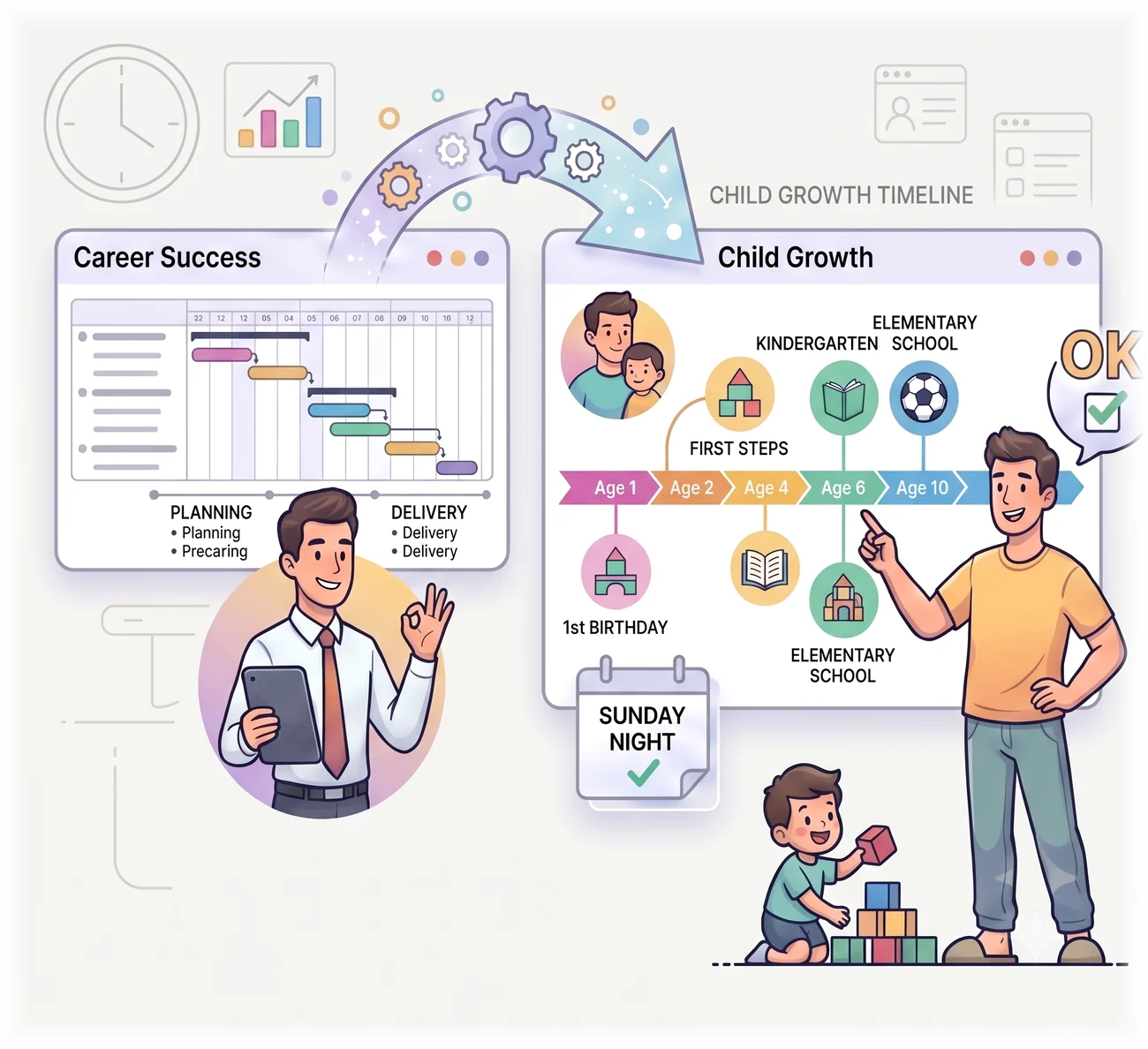
At work, someone breaks the big goal into stages, puts it on a calendar and keeps an eye on it — which is why you deliver.
Raising a child is a multi-year project too. It just runs on whatever you can still remember at the end of a long day.
Sunday night, you no longer sit down to work out the week. doandplay has already drafted it — you just look it over.
No card required · Tracking free forever · Cancel anytime
Piano is just the example here — it works for anything. Maths, writing, reading, science, or an instrument, a sport, a second language. If it only shows results after a year or three of steady work, it belongs here.
Setting the goal is the easy part — a full piece in three years, a real narrative in two. The hard part is the layers in between: where each year should land, what this quarter is for, and therefore what half an hour on Wednesday is actually for. At work someone fills that in. At home nobody does.
"Don't forget he needs more practice on word problems" — said at dinner, gone by dessert. Nobody wrote it down, nothing got scheduled, and a week later neither of you can remember. You're both tired, and when it comes up again it turns into blame.
Usually not. They just don't know how many things there are today, what counts as finished, or whether they get to play afterwards. That open-endedness is what they're pushing back on — not the work.
It was never that you didn't care enough.
It's that home never had the system that makes work feel manageable.
Nobody learns to write in a year, or finishes an instrument in three. What separates children isn't a big weekend push — it's the years where the weeks didn't stop.
And long games fail one way: you only do it when you happen to remember. Someone has to work out where each year and each month should land, and then hold on to it — otherwise the nicest plan is abandoned in a fortnight. Say where you want your child to get to; Ember lays out the layers in between, and you glance at it and nod.
The expensive part of family life isn't time, it's handover. Whoever hears it says one line to Ember, and it gets written down, scheduled, and brought back at the right moment — no scrambling for your phone, no asking again two days later.
One sentence is enough. No task to create, no date to pick, no reminder to set.
Three things have slipped — want me to move them to today?
Overdue items don't just sit there piling up. Ember clears them with you.
Next week is still empty. Shall I draft it for you to look over?
Or don't — you're welcome to plan it yourself.
And you don't have to remember to open it. Ember notices what slipped and what's still empty, and comes to you — most tracking tools die in a fortnight precisely because they sit there waiting to be remembered.
Your child signs in with their own login card and sees only today: how long each thing takes, and what counts as finished. No goal tree, nobody else's progress, and nothing they can change.
Tick one off, one fewer left. Tick them all and the day is done — no need to ask "how much longer" again. Certainty is what makes them cooperate.
More than one person usually looks after a child: both parents, grandparents, a tutor. Whoever picks it up can open it and see what your child is working on and what comes next.
The adults' own errands live on the same board — no need to work out which child "book the dentist" belongs to. What used to be said out loud and forgotten becomes something everyone can see.
After school, meals and sleep, a week usually leaves you a dozen or so hours you actually control. Split that budget first, then fill it — rather than packing the calendar and wondering later why it didn't hold.
Leaving hours open is a decision too. A full calendar isn't the achievement — keeping it up is. The open slice stays on the plate on purpose, so this can run for years instead of collapsing in three months.
Same question, different answer — because one starts from nothing every time, and the other has been building a picture of this one child.
One sentence logs it or schedules it; an empty week gets a nudge. Every step it plans can be undone in one click.
Maths, writing, an instrument, a sport — each on its own track, several children without collisions, and today's list assembled for you.
Put things on a day, repeat them, tick them off. Consistency becomes visible, and a streak gives your child something to hold on to.
A generated username and 6-digit code, like the ones school hands out. Read-only, their own view, nothing they can break.
One link puts the week on a tablet or TV at home — no login, and everyone can see what today holds.
Every goal, every bit of progress, every check-in — export the lot whenever you want. The record stays yours, not locked in here.
Your child's information belongs to your child. We build to strict family and children's privacy standards, with the boundary enforced on the server — not by hiding things in the interface.
Goals, stages, every check-in — recording your child's progress is free forever, and stays yours. Subscribe when you want Ember to plan the weeks and keep watch. Priced in AUD.
Full tracking · any number of children · export anytime
Breaks down goals · plans the week · nudges you · 20,000 energy points a month, up to 60,000 banked
You don't have to be the parent who knows the most about education. You can be the parent whose word holds — and leave the watching, the chasing and the remembering to something that reads your child a little better each month.
No card required · Tracking free forever · Data stored in Australia